
Where AI assistants get facts about your business
Where AI assistants look depends on the product and mode. Google AI Overviews and AI Mode use Google's index, Copilot grounds many answers in web search, and ChatGPT, Perplexity and Claude run search crawlers that look things up live. Answers from training data alone can be outdated. Your website and listings are the sources you control.
The short version
- Google’s AI Overviews and AI Mode build answers from Google’s own search index.
- Microsoft says Copilot is grounded in web search results for many questions.
- ChatGPT, Perplexity and Claude each run a search crawler, plus a fetcher that visits a page when someone asks.
- Training data is the slow layer. Nobody publishes exactly what’s in it.
- There’s no general way to submit your facts to these tools; some offer feedback buttons. What you control is the pages and listings they read.
How does each assistant look things up?
Each company publishes a little about how its tool gathers information, mostly in pages written for website owners. Here is what each one says, as of October 31, 2026.
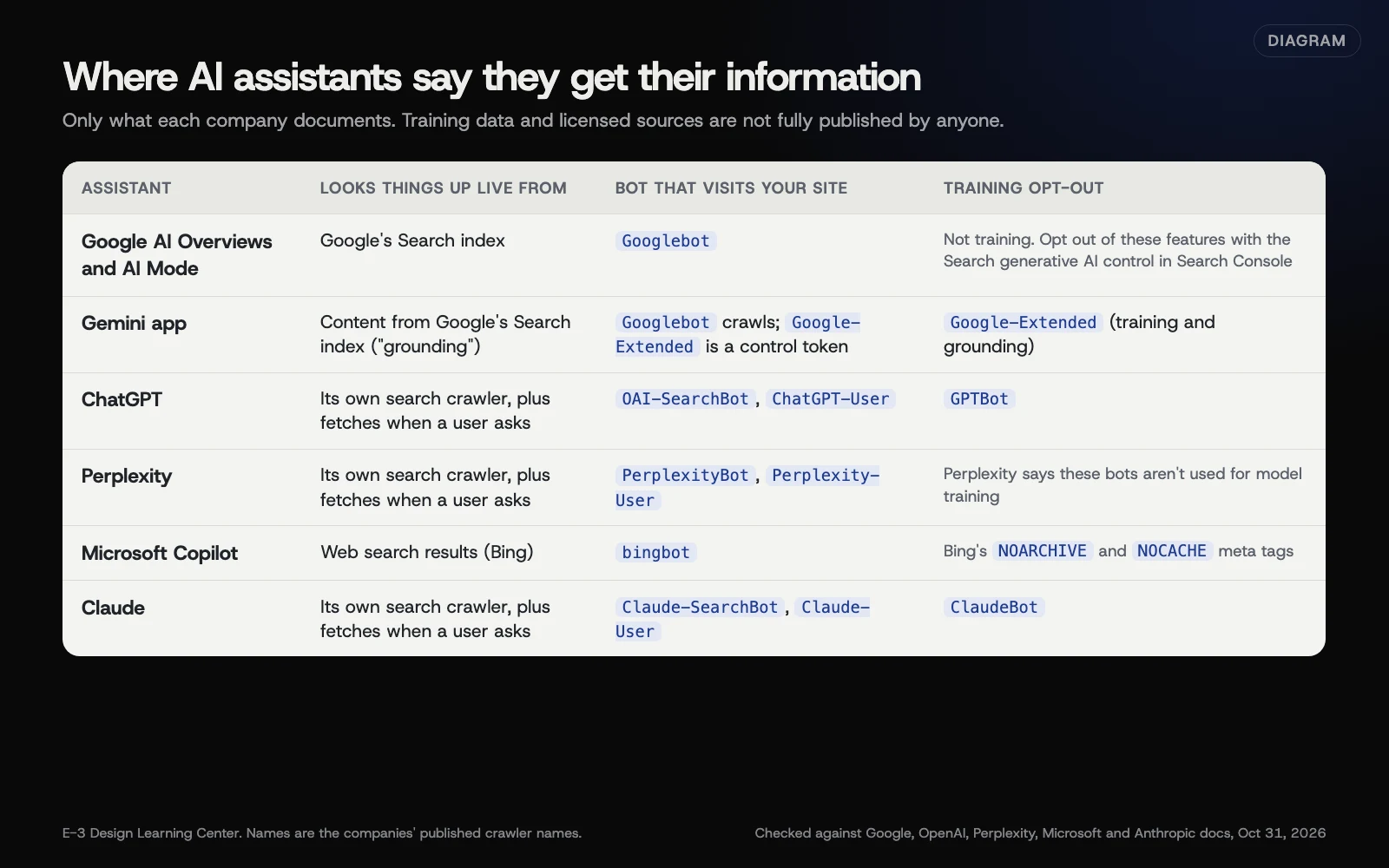 Diagram: what each company says about where its assistant looks things up, which bot visits your site and how to opt out of training. Checked against each company’s crawler documentation, October 31, 2026.
Google AI Overviews and AI Mode
Google’s guide to optimizing for generative AI features says these features rely on Google’s core ranking and quality systems. It describes two techniques. The first is retrieval-augmented generation: the AI pulls pages from the index before writing. The second is “query fan-out”: it runs several related searches to cover parts of the question. To be used as a source, Google’s AI features page says a page must be indexed and eligible to show a snippet. The crawler is plain Googlebot.
The Gemini app
Google’s crawler documentation describes “grounding” for Gemini Apps as “providing content from the Google Search index to the model at prompt time.” Gemini sometimes shows the sources it used, and Google’s Gemini help page offers a double-check button that compares a response with Google Search.
ChatGPT
OpenAI’s crawler page names three bots that matter here. OAI-SearchBot finds pages for ChatGPT’s search features. ChatGPT-User visits a page when a person’s request needs it. GPTBot collects content that may be used for training. OpenAI says sites that opt out of OAI-SearchBot “will not be shown in ChatGPT search answers,” though they can still appear as plain navigational links.
Perplexity
Perplexity’s bot documentation lists PerplexityBot, which surfaces and links websites in its results, and Perplexity-User, which fetches a page when a user asks a question. Perplexity says neither is used to collect content for training AI foundation models.
Microsoft Copilot
Microsoft’s Copilot transparency note says: “For certain conversations where users seek information, Copilot is grounded in web search results.” Those answers carry linked citations. Microsoft’s search engine is Bing, and Bing’s webmaster guidelines now cover Copilot, which is why our Bing Webmaster Tools guide matters.
Claude
Anthropic’s crawler article lists Claude-SearchBot for search, Claude-User for fetches a user requests, and ClaudeBot for training.
What about training data?
Every assistant also has a model trained on a large body of text collected before a cutoff date. When a tool answers from training alone, it can repeat facts that were true a year or two ago. That’s one likely reason an assistant gives an old phone number after you’ve fixed your website. That’s our inference, not something the companies document. An old page or listing it found by search is another common cause.
No company publishes a full list of what it trained on, or which licensed sources it uses. So we don’t guess here. The practical point is simple: the live search layer is the one you can influence quickly, and it reads your site, your listings and pages that mention you.
Why does this matter for a local business?
It tells you where to spend your time. When an assistant shows its sources, check these three places first:
- Your own website, if crawlers are allowed to read it. See AI crawler rules in robots.txt.
- The big search indexes, Google’s and Bing’s. Google’s AI features and Copilot draw on them, as above, so being properly indexed in both matters. See why Search Console matters.
- Listings and other sites that describe you, such as your Google Business Profile, directories and local news. See helping AI tell your business apart.
What do owners get wrong about this?
- Thinking there’s one “AI index” to submit to. There isn’t. Each tool has its own path, as the table shows.
- Blocking every bot with “AI” in its name. Some are search crawlers, and blocking them can take you out of that tool’s answers.
- Assuming the assistant knows you because you exist. If your site has no plain text about your services and area, there’s little for a live search to find.
- Trusting one test. Answers vary by wording, location and day. Look for patterns over several checks.
What if an assistant still gets you wrong?
Ask it where it found the fact, or look at the sources it links. Fix that source, or the page with the outdated fact, then check again later. Our answer on correcting AI answers about your business walks through it, and our guide to retiring outdated pages covers old content that keeps resurfacing.
How much does it cost, and how long does it take?
Nothing here costs money. Reading your own robots.txt and checking that you’re indexed takes minutes. How quickly answers change depends on each company’s crawl schedule; OpenAI, for example, says robots.txt changes for search take about 24 hours to apply.
How does E-3 handle this?
When we look at a client’s AI visibility as part of our SEO and AI search service, we start with these same three layers: can the crawlers read the site, is it indexed in Google and Bing, and do the listings agree. We explain what we find before recommending any change.
Related questions
Sources
- Optimizing your website for generative AI features on Google Search (Google Search Central)
- AI features and your website (Google Search Central)
- Google's common crawlers: Google-Extended (Google Search Central)
- Overview of OpenAI crawlers (OpenAI)
- Perplexity crawlers (Perplexity docs)
- Transparency Note for Microsoft Copilot (Microsoft Support)
- Does Anthropic crawl data from the web? (Claude Help Center)
- View related sources and double-check responses from Gemini Apps (Gemini Apps Help)
Next step
- Next: How to set robots.txt rules for each AI crawlerThe next guide in AI visibility.
- Free website checkPublic checks on your own site, then an action plan of what to fix first.
Still stuck? Ask E-3 for an answer from our help guides.
Rather we handled ai visibility for you?
It’s part of what we do every week for small businesses, as part of seo and ai search. Start with a free check of your site and profile, or call and ask.