
Privacy and cookies for a small business website
Most small business sites need three things: a privacy policy that matches what the site really collects, consent before non-essential cookies where EU or UK rules apply to you, and a habit of keeping less data for less time. US state laws mostly add opt-outs, often only above size thresholds. This isn't legal advice.
The short version
- Write down what your site collects and which outside tools load on it. Everything else depends on that list.
- Post a privacy policy that matches the list, in plain words, linked from every page.
- Do EU or UK rules apply to you, because you serve or track people there? Ask before non-essential cookies, apart from narrow exceptions, and make Reject as easy as Accept.
- Check whether a US state privacy law applies to you. Most have size thresholds; a few rules apply to almost everyone.
- Collect less, keep it for less time, and have a plan for when someone asks what you hold.
This isn’t legal advice. Privacy law depends on where you and your visitors are, what you do with the data, and your industry. For anything unclear, ask a lawyer who handles privacy.
How do I get my site’s privacy in order?
Work through these five steps in order. Each one links to a guide with the detail, checked against regulators’ own guidance on October 31, 2026.
1. Make an inventory
Open your website and list what it collects and who else it talks to. Look for:
- Forms: contact, quote, booking, newsletter and job application forms, and every field on them.
- Analytics: Google Analytics, Microsoft Clarity, a WordPress stats plugin, or anything similar.
- Advertising: the Meta pixel, Google Ads tags, LinkedIn Insight tag and remarketing tools.
- Embeds: YouTube videos, Google Maps, booking widgets, chat bubbles, review widgets and social feeds.
- Where data lands: your website’s saved entries, staff inboxes, your CRM, spreadsheets, your email list tool and backups.
If you’re not sure what loads, our free tools hub explains how to check your site with Google Tag Assistant. Your web company can also give you the list.
2. Write a privacy policy that matches
A privacy policy is a promise. The FTC’s privacy and security guidance tells businesses to honor the promises in their policy. The FTC treats misleading privacy claims as deceptive. So the best policy is short, specific and true. It says who you are and what you collect. It says why, who you share it with, how long you keep it, and how to reach you.
California’s online privacy law, CalOPPA, applies to any commercial website that collects personal information from California residents, with no size threshold. The California Attorney General’s guide to privacy policies lists what a policy must cover. That’s the types of information collected and the kinds of companies it’s shared with. It’s also how people can review or change it, the effective date, and how the site responds to Do Not Track signals. Our guide to what a small business privacy policy should cover has a full checklist.
3. Decide if you need cookie consent
This is the part most owners get wrong in one direction or the other. Europe and the UK use an opt-in model: you ask before setting cookies that aren’t strictly necessary. Most US state laws use an opt-out model: people can tell you to stop selling or sharing their data, or stop targeted ads.
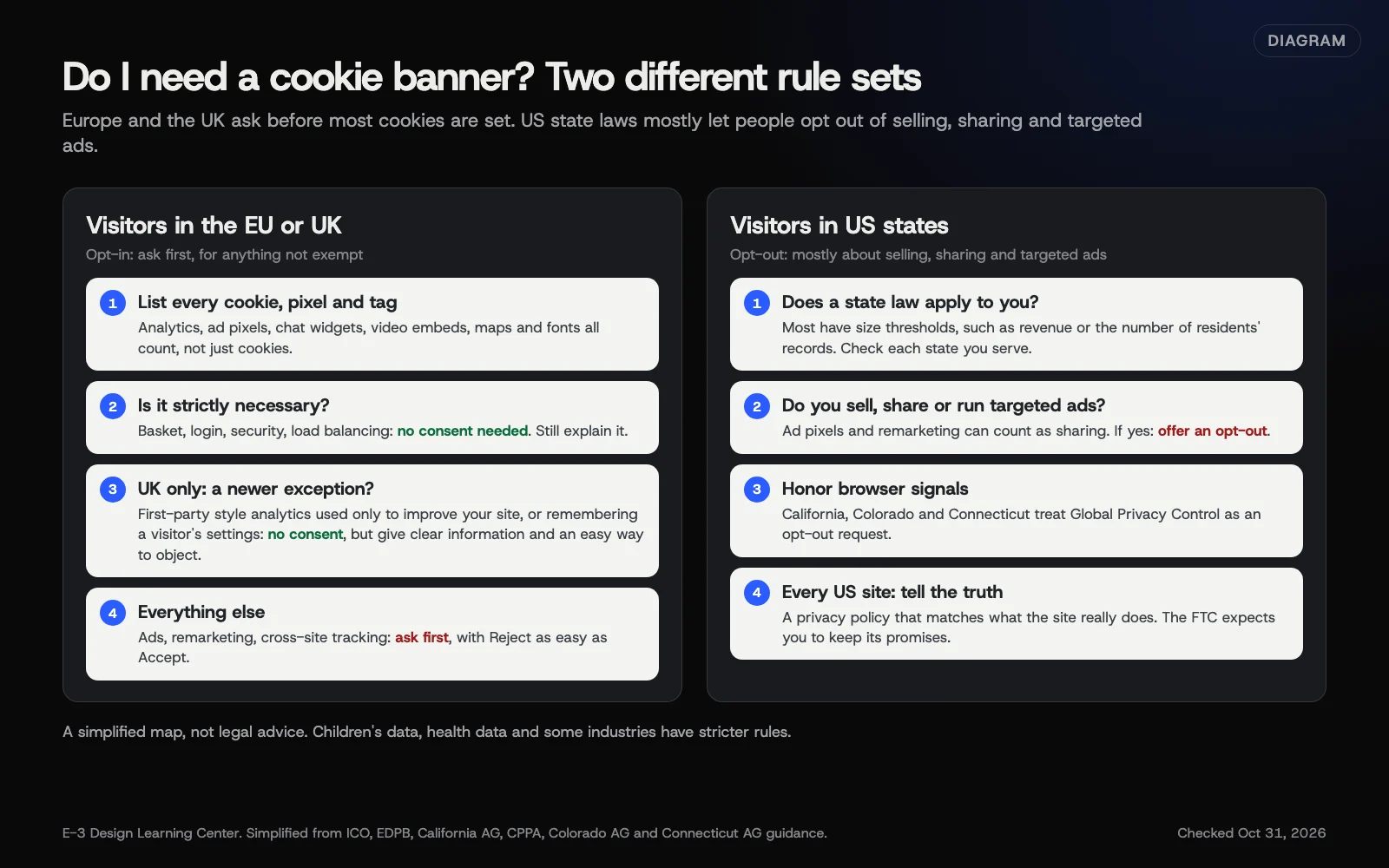 Diagram: the EU and UK opt-in model next to the US state opt-out model, simplified. Based on ICO, EDPB, California, Colorado and Connecticut guidance (October 2026). Not legal advice.
Do you have EU visitors? The European Commission’s page on who the GDPR applies to says it can cover a business outside the EU. That’s when it offers goods or services to people in the EU or monitors their behavior. A plumber in Ohio with no European customers is in a very different spot from a shop that ships to France. Our guide do I need cookie consent? walks through the questions, and making a consent banner accessible covers the design.
4. Check the US state laws
California, Colorado, Connecticut, Texas and a growing list of other states have broad privacy laws. Most only apply above a size threshold. California’s CCPA, for example, applies to for-profit businesses that do business in California and meet one of three tests. The CPPA’s threshold page sets the revenue test at $26,625,000 from January 1, 2025, after an inflation adjustment. The other tests are data on 100,000 or more California residents or households, or half or more of revenue from selling or sharing data.
Small doesn’t always mean exempt. The Texas Attorney General says Texas’s law mostly exempts small businesses, as the SBA defines them. They still need consent before selling sensitive data. And several states treat the browser’s Global Privacy Control signal as a valid opt-out. See which US state privacy laws apply to a small business and what Global Privacy Control means for your site.
5. Keep less, and be ready for requests
The FTC’s guide to protecting personal information boils it down to “Keep only what you need for your business.” That’s good law and good security. Ask for less on forms. Let entries delete themselves after a set time, once you’ve checked what you must keep for tax, legal or insurance reasons. Give staff access only to what they need. Each step cuts what can leak. Our guide on what your forms collect and how long to keep it shows how. Our guide on how to handle a data request covers the day someone asks.
What this looks like for a typical local business
Take an example: a roofing company in Pennsylvania with a WordPress site. It has a quote form, Google Analytics, a Google Map on the contact page and a Facebook pixel from an old ad campaign. Its customers are all local. (This is an illustration, not a real client.)
- Inventory: four tools plus the form. The pixel hasn’t been used in two years.
- Clean-up: remove the pixel. That’s one less company receiving visitor data, and one less reason for a banner.
- Policy: a one-page policy naming the form, the host, the email service, Google Analytics and the map, with a Do Not Track line for California visitors.
- Consent: with no customers or tracking aimed at Europe and no ad tracking left, a full consent banner may not be needed. The owner checks that with an adviser.
- Retention: quote requests that don’t turn into jobs are deleted after a set period. Inbox copies are cleared monthly.
- Requests: a short note in the office manual on what to do if someone asks for their data.
The same business running retargeting ads, or shipping products to Europe, would have more to do. That’s why the inventory comes first.
Which guides go deeper?
Each guide answers one question:
- What should a small business privacy policy cover? The sections regulators list, in plain words, and the mistakes that make a policy untrue.
- Do I need cookie consent on my website? How the EU, UK and US rules differ, including the UK’s new analytics exception.
- Which US state privacy laws apply to a small business? Thresholds, opt-outs and the rules that apply regardless of size.
- What is Global Privacy Control, and do I have to honor it? The browser signal several states treat as an opt-out.
- What is Google Consent Mode v2? What it does, basic versus advanced, and who needs it.
- Can I measure my website with fewer cookies? GA4 settings, cookieless tools and their trade-offs.
- How long should I keep form submissions? Finding every copy and setting a retention schedule.
- Does COPPA apply to my website? The children’s privacy rule and its 2025 changes.
- How do I handle a request to see or delete someone’s data? Deadlines, identity checks and WordPress’s built-in tools.
- Which vendors handle my customers’ data, and what should I check? Processors, contracts and the tools you’ve added over the years.
- How do I make a cookie banner accessible? Keyboard, screen readers, focus and fair button design.
Why does privacy matter for a small business site?
Three reasons, in order of how often they come up.
Trust. People are wary of forms. A clear policy link next to the submit button, and a form that only asks for what’s needed, tells them you’ve thought about it.
Your tools require it. Google’s EU user consent policy covers visitors from the European Economic Area, the UK and Switzerland. Sites using Google products must get consent where the law requires it and keep records of it. The Google Analytics terms say you must post a privacy policy. It must mention your use of cookies and of Google Analytics. Microsoft says that, starting October 31, 2025, Clarity enforces consent signals for visits from the EEA, UK and Switzerland.
The law, where it applies. Regulators in Europe, the UK and US states do act on websites. In the US, the FTC can act on privacy promises a business doesn’t keep, whatever its size.
What are the most common mistakes?
- A copied policy. A policy lifted from another site describes another business’s tools. It can promise things you don’t do, which is worse than saying less.
- A banner that doesn’t block anything. Many banners show a message while analytics and ad tags fire anyway. The banner has to control the tags.
- No Reject button. The EDPB’s Cookie Banner Taskforce report recorded the view of most European regulators. An Accept button with no equal way to refuse doesn’t give valid consent.
- Forgotten tools. An old Facebook pixel or chat widget still loads years after anyone used it.
- Keeping everything forever. Years of form entries, inbox copies and spreadsheets, none of which anyone needs.
- Asking for too much. Date of birth, full address or ID numbers on a simple contact form.
Which rules have changed recently?
Older guides still teach some outdated rules. Here’s where things stand on October 31, 2026.
- UK: new cookie exceptions. The Data (Use and Access) Act 2025 changed the UK’s cookie rules. The ICO’s storage and access technologies guidance, was finalised on April 29, 2026. It lists five exceptions, One is “statistical purposes,” for analytics used only to improve your site. You still have to explain it and give people a simple way to object. Advertising is not covered.
- Google Consent Mode v2. Google added two consent settings,
ad_user_dataandad_personalization. From March 2024, ad personalization and remarketing for European traffic need consent signals. See our consent mode guide. - COPPA amendments. The FTC’s amended children’s privacy rule was published on April 22, 2025 and took effect June 23, 2025. Most businesses had until April 22, 2026 to comply. See does COPPA apply to my website?
- CCPA regulations. California’s privacy agency adopted new rules in September 2025 on risk assessments, cybersecurity audits and automated decision-making. Its consolidated regulations are dated effective January 1, 2026.
- Clarity consent. Microsoft Clarity began enforcing consent signals for European visitors on October 31, 2025.
What if something goes wrong?
- Someone asks what data you hold, or asks you to delete it. Log the date and follow our data request guide. Deadlines are short.
- You find a tool loading that you didn’t know about. Remove it if nobody uses it. If you need it, add it to your policy and, where required, your consent banner.
- A form was collecting something sensitive. Remove the field, delete the old entries you don’t need, and check every place copies went.
- You get a letter from a regulator or a lawyer. Don’t ignore it and don’t argue by email. Talk to a lawyer before you reply.
How much does it cost, and how long does it take?
The inventory takes an hour or two for a typical small site. Writing or fixing a policy takes an afternoon. WordPress includes a free privacy policy page helper, and many consent tools have free tiers for small sites, though limits vary by vendor. If a law firm drafts your policy, ask them for a quote; prices vary widely.
How does E-3 handle this?
We’re a web studio, not a law firm, so we don’t write legal policies or tell you which laws apply. We handle the technical side as part of our website care service. We can list what loads on your site and remove tools nobody uses. We can set up form retention. We can install and test a consent banner so it really blocks tags until a visitor chooses. You decide which changes to make. Settings and tag changes can usually be reversed. Deleted data can’t be brought back, so check what you need to keep before anything is deleted.
Related questions
Sources
- Guidance on the use of storage and access technologies (ICO)
- What are the exceptions? (ICO storage and access technologies guidance)
- Report of the work undertaken by the Cookie Banner Taskforce (EDPB, January 2023)
- Who does the data protection law apply to? (European Commission)
- California Consumer Privacy Act (CCPA) (California Attorney General)
- Updated monetary thresholds in CCPA (California Privacy Protection Agency)
- Attorney General issues guide on privacy policies and Do Not Track disclosures (California Attorney General)
- Privacy and security business guidance (FTC)
- Protecting personal information: a guide for business (FTC)
- Google Analytics terms of service (Google Marketing Platform)
- EU user consent policy (Google)
- Texas Data Privacy and Security Act (Texas Attorney General)
- CCPA regulations (California Privacy Protection Agency)
- Settings Privacy screen (WordPress documentation)
- Consent mode overview (Google Tag Platform)
- Children's Online Privacy Protection Rule, final amendments (Federal Register, April 22, 2025)
- Consent Mode (Microsoft Clarity documentation)
Every Privacy and cookies guide
- What should a small business privacy policy cover?A small business privacy policy should say who you are, what you collect and how, why you use it, which outside companies get it, how long you keep it, what choices and rights people have, and how to contact you. Above all it must match what your site really does. This isn't legal advice.
- Do I need cookie consent on my website?You likely need cookie consent if EU or UK rules apply to you, for example because you serve or track people there, and your site sets cookies or similar tracking that isn't strictly necessary, such as ad pixels. The UK and some EU countries exempt narrowly set-up analytics. US state laws mostly require opt-outs. Not legal advice.
- Which US state privacy laws apply to a small business?Most US state privacy laws apply only above a size threshold, such as California's $26.6 million revenue test or handling data on 100,000 residents. Many small businesses fall below. Some rules still reach small sites: the California privacy policy law, a Texas limit on selling sensitive data, and the FTC rule against broken promises. Not legal advice.
- What is Global Privacy Control, and do I have to honor it?Global Privacy Control (GPC) is a browser setting that tells every site a person visits not to sell or share their data. California, Colorado and Connecticut treat it as a valid opt-out for businesses their privacy laws cover. If a law applies to you and you sell or share data, your site must respect it. Not legal advice.
- What is Google Consent Mode v2, and do I need it?Google Consent Mode tells Google Analytics and Google Ads tags what a visitor chose in your cookie banner, so the tags behave accordingly. Version 2 added two settings for advertising data. If you use Google tags and get visitors from the EEA, UK or Switzerland, Google expects consent signals. It isn't a banner itself. This isn't legal advice.
- Can I measure my website with fewer cookies?Yes. You can tighten Google Analytics 4 by shortening data retention, shortening cookie lifetimes and using consent mode, or switch to a privacy-focused tool that counts visits without cookies. Each choice trades some detail for less tracking. Count your leads either way, because that's the number that matters most. This isn't legal advice.
- How long should I keep form submissions?Keep form submissions only as long as you have a real business reason, then delete them. No US or UK law sets one fixed period for contact forms, so you decide, write it down and stick to it. Start by finding every copy: website entries, inboxes, your CRM, spreadsheets and backups. This isn't legal advice.
- Does COPPA apply to my small business website?COPPA applies if your site or app is aimed at children under 13 and collects their personal information, or if a general-audience site knowingly collects it. Then you need a specific privacy notice and verifiable parental consent first. The FTC's amended rule took effect June 23, 2025, with most compliance due April 22, 2026. Not legal advice.
- How do I handle a request to see or delete someone's data?Log the date, verify identity for requests to see, correct or delete data using details you already hold, search every place it might be, act and reply in writing. Honor opt-outs of sale or sharing without an identity check. California allows 45 days for most requests; the EU and UK, one month. Not legal advice.
- Which vendors handle my customers' data, and what should I check?Every tool on your site that receives visitor or customer data is a vendor you're responsible for choosing: your host, form plugin, email service, CRM, analytics and ad platforms. List them, check each one's data terms and security, remove the ones you don't use, and name them in your privacy policy. This isn't legal advice.
- How do I make a cookie banner accessible and fair?An accessible, fair cookie banner can be used with a keyboard and a screen reader, doesn't hide the content someone is focused on, and works on a small phone. Accept and Reject sit side by side with equal weight, optional categories start switched off, and a footer link lets people change their mind. This isn't legal advice.
Common questions
- Does a small US business website need a privacy policy?
- If it collects personal information such as names and emails from California residents, California's online privacy law (CalOPPA) expects a posted policy, and there's no size threshold. Google Analytics' terms also require one. In practice, every business site with a form should have one.
- Do I need a cookie banner if all my customers are in the US?
- Usually not in the EU sense. US state laws don't generally require consent before analytics cookies. But if a state law applies to you and you run ad tracking, you'll need an opt-out and must honor signals like Global Privacy Control.
- Is there a plugin that makes my site compliant?
- No. A consent plugin or policy generator can help, but compliance depends on what your site actually does and how you set the tool up. Check that the banner blocks tags before consent and that the policy describes your real tools.
Next step
- Start here: What should a small business privacy policy cover?The first guide in Privacy and cookies.
- Free website checkPublic checks on your own site, then an action plan of what to fix first.
Still stuck? Ask E-3 for an answer from our help guides.
Rather we handled privacy and cookies for you?
It’s part of what we do every week for small businesses, as part of website care. Start with a free check of your site and profile, or call and ask.