
What does the FTC say about AI claims and AI-written reviews?
The FTC says there is no AI exemption from consumer protection law. Claims about what an AI product or service does must be true and backed by evidence, and its fake reviews rule bans reviews by people who do not exist, including AI-generated ones. In December 2025 the FTC set aside one 2024 AI order. Not legal advice.
The short version
- Ordinary consumer protection law applies to AI. The FTC says there’s no AI exemption.
- If you say a product or service uses AI, or what the AI does, it must be true and provable.
- Never post AI-written reviews or testimonials. The FTC’s rule covers reviews by people who don’t exist.
- The FTC set aside its 2024 Rytr order in December 2025, but says it still pursues AI deception.
- This isn’t legal advice. For your own situation, ask a lawyer.
What has the FTC done about AI?
These come from the FTC’s own press releases, case by case.
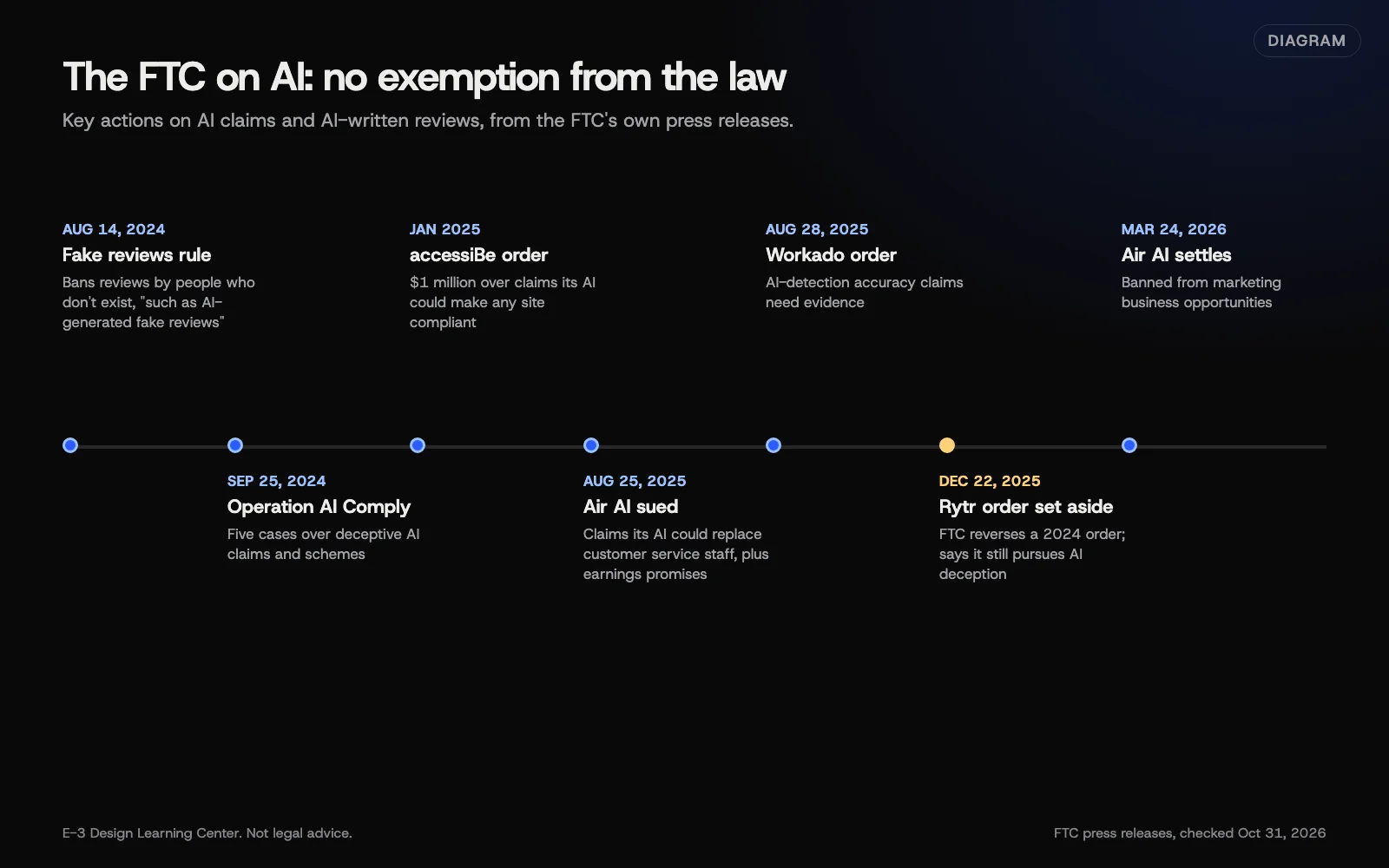 Diagram: FTC actions on AI claims and AI-written reviews, August 2024 to March 2026, from the FTC’s own press releases.
The fake reviews rule (August 14, 2024)
The FTC’s final rule on fake reviews bans reviews that misrepresent that they’re by someone who doesn’t exist, “such as AI-generated fake reviews,” along with buying reviews and other practices. Our reviews hub has the full guide to the fake reviews rule, so we won’t repeat it here.
Operation AI Comply (September 25, 2024)
The FTC announced five cases against businesses using AI claims to mislead people. They included a service sold as an AI “robot lawyer” that the FTC said was never tested against a human lawyer, and several schemes promising AI-powered online stores would earn passive income. Then-Chair Lina Khan said “there is no AI exemption from the laws on the books.”
An overlay company (January 2025)
The FTC ordered accessiBe to pay $1 million over claims that its AI tool could make any website compliant with accessibility guidelines. Our answer on accessibility overlays covers what that means for your site.
Workado (August 2025)
Workado sold a tool that claimed to tell AI-written text from human writing. The FTC said the company overstated its accuracy for everyday users, when the model behind it was trained to classify academic writing. The final order, announced August 28, 2025, bars claims about how well its AI detection works unless the company has “competent and reliable evidence” for them.
Air AI (August 2025 and March 2026)
The FTC sued Air AI on August 25, 2025, saying it marketed its “conversational AI” as able to “replace human customer service representatives,” along with earnings and refund promises. According to the FTC, small business owners were among those who bought it. A March 2026 settlement bans the company and its owners from marketing business opportunities.
What changed in 2025?
On December 22, 2025, the FTC reopened and set aside its 2024 order against Rytr, an AI writing tool that had offered a “Testimonial & Review” feature. The FTC said the original complaint didn’t meet the FTC Act’s legal requirements and that the order unduly burdened AI innovation, citing the White House AI Action Plan. It also said it will still hold accountable those who use AI to break the law or deceive consumers about what their AI can do.
Two points matter for a small business. First, the set-aside was about a tool maker, not the fake reviews rule; posting fake reviews is still banned under that rule. Second, the FTC removed some older blog posts about AI from its site in 2025, as TechCrunch reported in October 2025. Older guides may still quote them. We rely on the FTC’s press releases and orders instead.
What does this mean for my business?
- Be accurate about AI in your marketing. “AI-powered” is a claim. So is “our AI answers every call perfectly.” Only say what you can show.
- No made-up results. Don’t promise customers savings, rankings or earnings from an AI service unless you have real evidence.
- Never post AI-written reviews, testimonials or endorsements, or ask staff or friends to post them.
- Be honest about chatbots. If an assistant talks to customers, it should say it’s automated. See AI chat on your website.
- Be skeptical of vendors. Several FTC cases involved AI products sold to small businesses with big promises. Ask for evidence and test before you commit.
Why does this matter?
The FTC Act’s ban on deceptive practices applies to small businesses as much as large ones. The cases above show the FTC treats an AI claim like any other claim: if it’s false or unsupported, it can be deceptive. Beyond the law, customers who feel tricked by a fake review or a bot posing as a person don’t come back.
What are the common mistakes and edge cases?
- Letting a marketing tool “suggest” reviews and posting them under customers’ names.
- Copying vendor claims onto your own site, like “our AI never makes mistakes.”
- AI personas with human names and photos and no disclosure.
- AI-generated “before and after” photos presented as real jobs. See AI images and copyright.
- Assuming the Rytr set-aside means anything goes. It doesn’t change the fake reviews rule or the ban on deception.
What if I think I’ve crossed a line?
Stop the practice, remove anything misleading from your site and profiles, and keep a record of what you changed and when. If you received a letter from a regulator or a lawyer, don’t ignore it; talk to your own lawyer. This isn’t legal advice. To report a business that’s deceiving people with AI, the FTC takes reports at ReportFraud.ftc.gov.
What does it cost, and how long does it take?
Checking your own site for AI claims and removing fake reviews costs nothing but time. An hour with your home page, services pages and review profiles is a reasonable start.
How does E-3 handle this?
E-3 doesn’t promise rankings, AI-answer placement or legal compliance. Review requests and replies are part of our leads and follow-up service: we draft them, a person checks them, and the client approves them before they’re sent or posted.
Related questions
Sources
- FTC announces crackdown on deceptive AI claims and schemes (FTC, September 25, 2024)
- Federal Trade Commission announces final rule banning fake reviews and testimonials (FTC, August 14, 2024)
- FTC approves final order against Workado, which misrepresented the accuracy of its AI content detection product (FTC, August 2025)
- FTC reopens and sets aside Rytr final order (FTC, December 22, 2025)
- FTC sues to stop Air AI from using deceptive claims (FTC, August 25, 2025)
- FTC removes Lina Khan-era posts about AI risks and open source (TechCrunch, October 20, 2025)
- FTC order requires online marketer to pay $1 million for deceptive claims that its AI product could make websites compliant (FTC, January 2025)
Next step
- AI tools for small business: the complete guideEvery guide in this topic, in order.
- Free website checkPublic checks on your own site, then an action plan of what to fix first.
Still stuck? Ask E-3 for an answer from our help guides.
Rather we handled ai tools for small business for you?
It’s part of what we do every week for small businesses, as part of seo and ai search. Start with a free check of your site and profile, or call and ask.