
The ADA Title II web rule: dates and who it covers
DOJ's 2024 Title II rule requires state and local government websites and apps to meet WCAG 2.1 Level AA. An April 2026 interim final rule moved the deadlines to April 26, 2027 for governments serving 50,000 people or more, and April 26, 2028 for smaller ones. It doesn't cover private businesses, except as contractors. This isn't legal advice.
The short version
- The rule covers state and local governments, their agencies, special districts, and some transit bodies.
- The standard is WCAG 2.1 Level AA, for websites and mobile apps.
- After an April 20, 2026 extension, the dates are April 26, 2027 (50,000 people or more) and April 26, 2028 (smaller governments and special districts).
- Private businesses aren’t covered directly. Contractors who provide services for a government are expected to follow it.
- There are five narrow exceptions, such as archived pages and old documents nobody needs to use.
This isn’t legal advice. It reports what ada.gov said on October 31, 2026.
What does the rule require, and when?
The Justice Department’s fact sheet on the rule says the rule was published on April 24, 2024. It requires web content and mobile apps that state and local governments provide, or make available through others, to meet WCAG 2.1 Level AA.
The original deadlines were two and three years out. On April 20, 2026, DOJ published an interim final rule that pushed them back a year. The dates now are:
| Who | Deadline |
|---|---|
| State and local governments serving 50,000 people or more | April 26, 2027 |
| Governments serving fewer than 50,000 people | April 26, 2028 |
| Special district governments, of any size | April 26, 2028 |
The extension changed the dates only. The standard is still WCAG 2.1 Level AA.
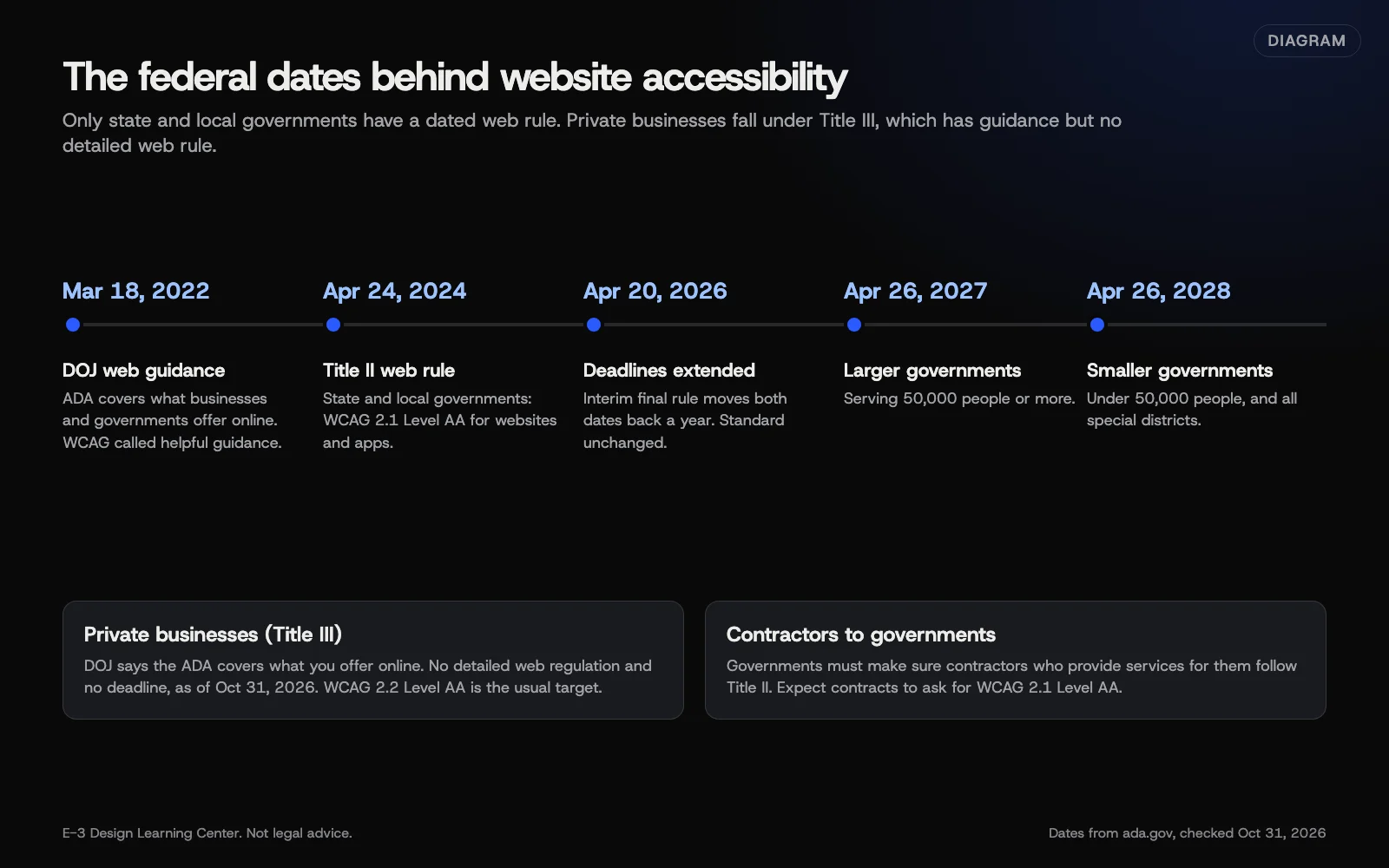 Diagram: the federal dates behind website accessibility, from DOJ’s 2022 guidance to the 2026 extension of the Title II rule. Dates from ada.gov, checked October 31, 2026.
Who counts as covered?
According to ada.gov, the rule applies to all state and local governments, including their departments and agencies. It also covers special purpose districts, such as a water or library district, Amtrak, and other commuter authorities.
What’s excluded?
The fact sheet lists five exceptions. Each has conditions, and all of them must be met:
- Archived web content. Made before the deadline, kept only for reference or records, stored in an archive area, and unchanged since.
- Old documents. Word, PDF, presentation and spreadsheet files posted before the deadline. This doesn’t cover documents people still use to apply for or reach a service.
- Third-party posts. Content the public posts, such as comments. Content the government, its contractors or its tools publish doesn’t qualify.
- Personal password-protected documents. Files about one person, property or account, behind a password.
- Old social media posts made before the deadline.
The fact sheet adds that these exceptions don’t remove other ADA duties. If someone needs an excepted document in an accessible form, the government still has to communicate effectively with them.
Does it apply to my private business?
Not directly. A shop, clinic or restaurant falls under Title III of the ADA, which covers businesses open to the public. For them, DOJ’s 2022 web guidance still applies: the ADA covers what they offer online, but DOJ has no regulation with detailed web standards for them. As of October 31, 2026, there’s no dated web deadline for private businesses.
There are two cases where the Title II rule reaches a business:
- You provide a service for a government. The fact sheet says governments must make sure contractors who provide public services for them follow Title II. If you run a parks booking site, a utility payment page or a school’s event registration, expect the contract to require WCAG 2.1 AA.
- You sell web tools to governments. Payment, forms, calendar and video platforms used by governments will be asked to meet the standard.
Even where it doesn’t apply, the rule matters. It’s the clearest statement yet of the standard DOJ expects, and WCAG 2.1 AA is a sensible floor for any site. Our answer on whether your business site needs to be ADA accessible covers the Title III side in brief.
Why does this matter for a small business?
Many small businesses do some work for local government: a printer that hosts a county’s forms, a web studio that runs a township site, a caterer with an online order page for school events. If that’s you, the contract may soon ask you to prove WCAG 2.1 AA. Knowing the dates now gives you time to test and fix before a renewal.
What are the common mistakes and edge cases?
- Reading the old dates. Many articles still give April 2026 and April 2027. Those were replaced on April 20, 2026.
- Assuming PDFs are exempt. Only pre-deadline documents that nobody uses to reach a service are. A current application form in PDF isn’t. See how to make PDFs and documents accessible.
- Thinking third-party tools are exempt. Payment, booking and calendar tools a government chooses are its content under the rule. Choose tools that meet WCAG 2.1 AA.
- Aiming at 2.1 when you could aim at 2.2. A site that meets WCAG 2.2 AA also meets 2.1 AA. Our guide to WCAG levels explains how versions and levels fit together.
- Excluding part of a page. WCAG conformance applies to whole pages and whole processes, such as an entire payment flow, per the W3C’s conformance rules.
What if this didn’t answer my question?
The rule has more detail than a fact sheet can hold, including how it treats mobile apps and conforming alternate versions. Read the full rule linked from the ada.gov fact sheet, and ask a lawyer how it applies to your contract. If a government client asks you for proof of conformance, an honest test report plus a public accessibility statement is a good start. If you’ve received a complaint or letter, see what to do about a demand letter.
DOJ also takes complaints from the public. Its introduction to the ADA explains how to file one.
How much does it cost, and how long does it take?
Reading the rule is free, and DOJ doesn’t charge to comply. The cost is the testing and fixing, which depends on how many pages, documents and tools you have. A government site with years of PDFs takes far longer than a five-page site.
How does E-3 handle this?
E-3 builds sites to WCAG Level AA and fixes problems in the site itself. If you’re a contractor asked to meet the Title II standard, we can test the pages you run and give you a written plan. Fixes are part of website care, and bigger changes are tested on a staging copy first. We can’t promise legal compliance.
Related questions
Next step
- Next: WCAG levels A, AA and AAA: which one do I need?The next guide in Website accessibility.
- Free website checkPublic checks on your own site, then an action plan of what to fix first.
Still stuck? Ask E-3 for an answer from our help guides.
Rather we handled website accessibility for you?
It’s part of what we do every week for small businesses, as part of website care. Start with a free check of your site and profile, or call and ask.