
Turn reviews into fixes: a monthly routine
Once a month, gather every new review from every site into one list, tag each by topic, such as speed, price, communication or quality, and count the repeats. Fix the cause of the problem that comes up most by changing how you work, say what changed in your replies, and check next month whether those complaints dropped.
The short version
- Once a month, put every new review from every site in one list.
- Tag each by topic: speed, communication, price, quality, staff.
- Count the repeats. One complaint is a story; three is a pattern.
- Fix the cause of the top pattern with one change to how you work. Safety, privacy or discrimination complaints can’t wait for a pattern: act on the first one.
- Tell customers what changed, and check next month whether it worked.
How do I turn reviews into fixes?
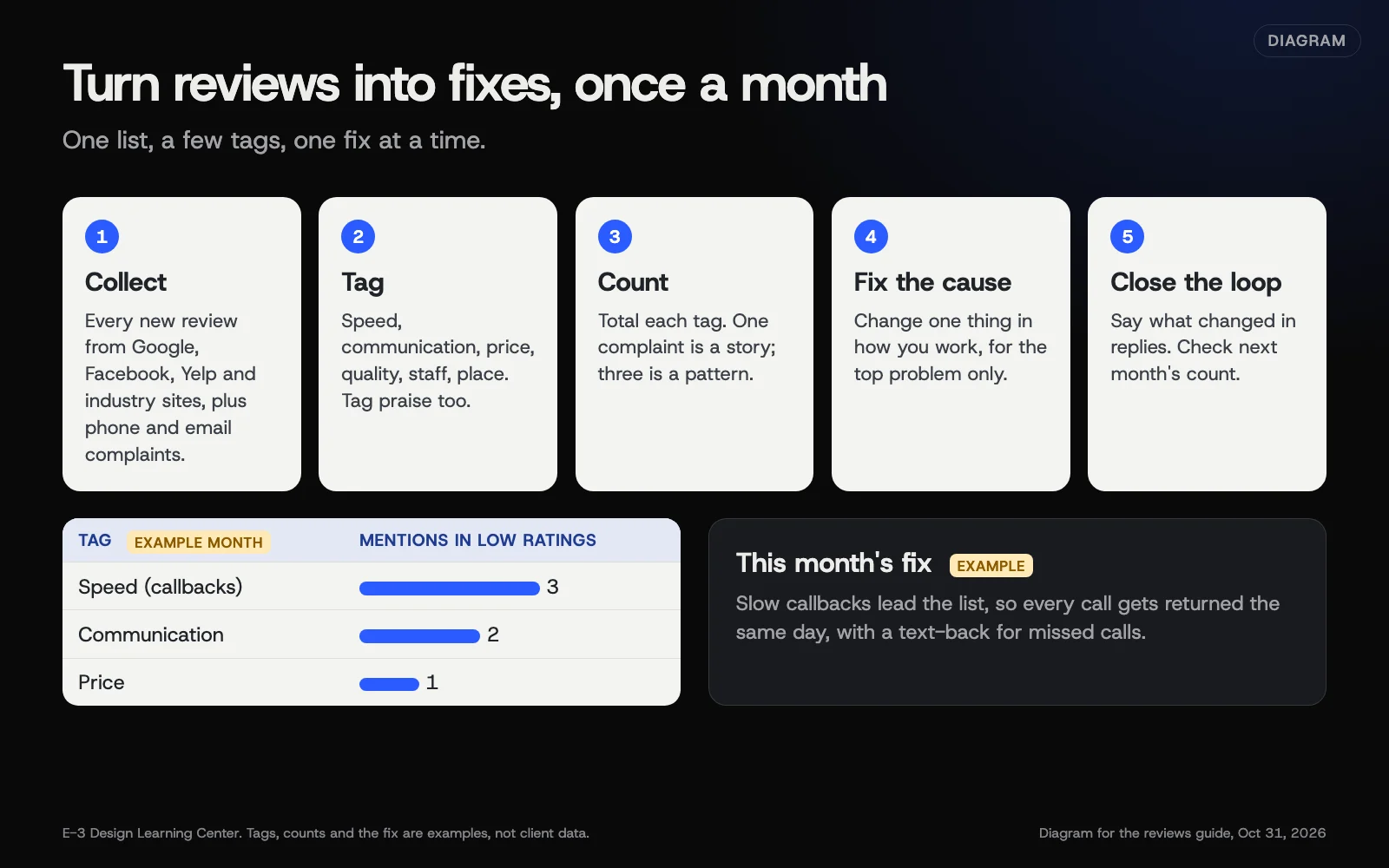 Diagram: a monthly loop for turning review feedback into fixes. Example tags and counts are marked as examples.
Step 1: Collect
Set a recurring 30 minutes at the start of each month. Copy every new review, good and bad, from Google, Facebook, Yelp and any industry sites into one spreadsheet: date, site, rating and the text. Add complaints that came by phone or email too; they’re the same feedback, just private. Include Yelp reviews that aren’t recommended; they’re often real customers.
Step 2: Tag
Give each review one or two topic tags. A short, fixed list works best:
| Tag | What it covers |
|---|---|
| Speed | Waiting for a callback, a quote, an appointment or a finished job |
| Communication | Not being told about delays, unclear quotes, no follow-up |
| Price | Surprise costs, value for money |
| Quality | The work itself, mistakes, things that had to be redone |
| Staff | Friendliness, professionalism, a named person |
| Place | Parking, cleanliness, hours, finding you |
Tag praise too. It tells you what to protect.
Step 3: Count
Total each tag for the month, and keep a running count across months. Look for the tag that keeps coming up in low ratings, and for any praise tag that’s slipping.
Step 4: Fix the cause
For the monthly routine, pick the top problem. Anything about safety, privacy, discrimination or a legal risk is different: deal with it the day you read it, even if it’s a single review, and get proper advice where you need it. For the top problem, ask why it happens, and change one thing in how you work. For example, if reviews keep mentioning slow callbacks, the fix might be a rule that every call is returned the same day, or a missed-call text-back so nobody waits in silence. That’s an example; your fix depends on your business.
Step 5: Close the loop
- In replies: when you answer a complaint about the problem you’ve fixed, say what changed. Google’s reply guidance encourages replies that are relevant and specific.
- With staff: share the praise and the pattern, not blame for one review.
- Next month: check whether that tag dropped. If it did, pick the next one.
Why bother?
Customers who complain in a review are telling you what other customers felt and didn’t write down. Fixing the cause may mean fewer bad reviews later, which no reply can achieve on its own. It also gives you something honest to say in public replies: “We’ve changed how we do this.”
Google’s local ranking page says positive reviews and helpful replies can help your business stand out. Better service is the honest route to both.
What are the common mistakes and edge cases?
- Reacting to one loud review. For everyday complaints, wait for the pattern before changing how you work. A single report of a safety, privacy or discrimination problem still needs action straight away.
- Reading only the bad reviews. Praise shows what customers value most.
- Tracking only Google. Facebook, Yelp and industry sites often hold different customers’ views.
- Blaming staff by name for a single review. Fix the process, not the person.
- Asking unhappy customers to edit their review after a fix. Don’t pressure anyone. The FTC’s Endorsement Guides FAQ warns against asking customers to change or delete negative reviews.
- Changing your review requests to avoid unhappy customers. That’s selective asking, which Google bans.
What if this didn’t work?
- You don’t get enough reviews to see patterns. Combine three months, and add phone and email complaints. Then look at your request habit; see the rules on asking.
- The same complaint keeps coming after a fix. The fix didn’t reach the cause. Ask a few customers directly what went wrong.
- Reviews mention something you can’t change, like parking. Say so honestly on your website and in replies, so people know what to expect.
How much does it cost, and how long does it take?
A spreadsheet is free. The monthly routine takes 30 to 60 minutes. Review management tools can collect reviews from several sites automatically for a subscription; they save the copying, not the thinking.
How does E-3 handle this?
Our leads and follow-up service covers review replies and includes one leads inbox. Each reply draft is checked by a person and approved by you before it’s posted. If you’d like help setting up a monthly review summary, ask us what we can include.
Related questions
Next step
- Reviews: the complete guideEvery guide in this topic, in order.
- Free website checkPublic checks on your own site, then an action plan of what to fix first.
Still stuck? Ask E-3 for an answer from our help guides.
Rather we handled reviews for you?
It’s part of what we do every week for small businesses, as part of leads and highlevel. Start with a free check of your site and profile, or call and ask.